Most Local Services Ads advertisers are about to lose something they didn't know could be lost: the record of what their advertising actually did. Two separate Google changes are behind it. Neither was aimed at you, and both are in Google's published documentation. Here's what's going, why it matters more than it looks, and how to keep it.
Change one: the migration leaves your reports behind
As Google moves Local Services Ads into Performance Max (see our complete guide), your leads make the move. Contact details, message threads and older call recordings go into the Leads page in Google Ads.
Your reports don't. Google's migration documentation says previous campaign-level performance metrics, "such as past impressions, clicks, weekly spend, and ad-level performance reports," don't transfer. Google's advice is to download them before the move.
These are two different things, and people mix them up. A lead list tells you who called. Reporting history tells you what your money bought: which weeks worked, which months cost too much per lead, how last summer compared with this one. The second is what you use to make decisions, and it's the part that gets left behind.
Change two: a rolling deletion that never stops
The second change has nothing to do with the migration and got even less attention. Under Google's advertising data retention policy, effective June 1, 2026:
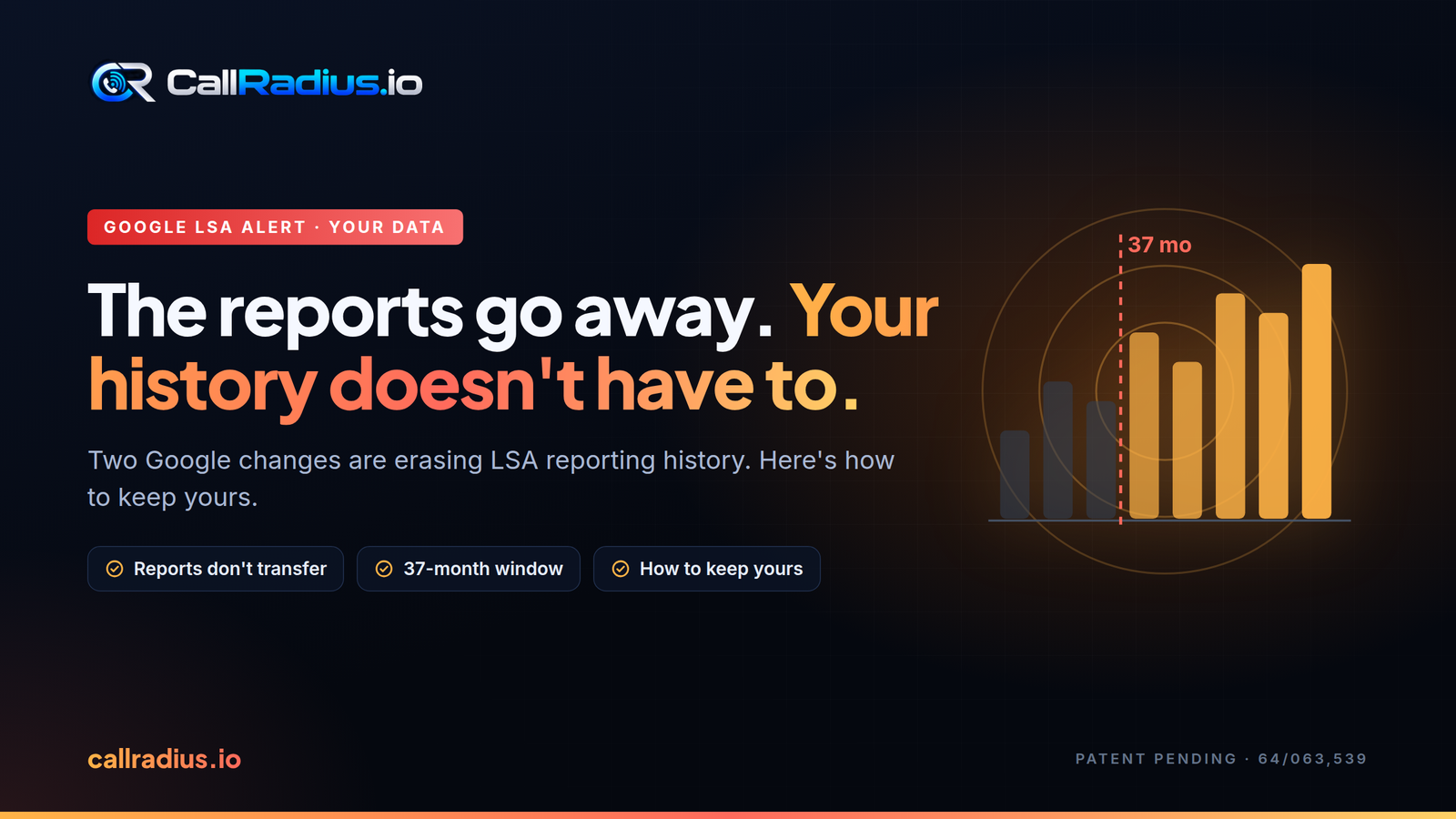
- Hourly, daily and weekly reporting data is available for 37 months.
- Monthly, quarterly and annual data is available for 11 years.
- After that, in Google's words, "the data will not be accessible via the Google Ads interface or APIs."
This isn't a one-time event. It's a rolling window. Every month, another month of your oldest detailed data passes the 37-month line and becomes unavailable. It keeps happening for as long as you advertise.
Why the detail matters more than the totals
Keeping monthly totals for 11 years sounds generous. But monthly totals can't answer the questions that change a decision:
- Which days of the week bring leads that book? You need daily data for that.
- Did the budget change on the 14th help or hurt? You need data from before and after that date, not a monthly average that blends the two.
- Is this August's slowdown normal for us, or a problem? You need August at weekly detail, from several years back.
- What did we really pay per distinct customer, as opposed to per conversion event? Repeat callers are counted as separate leads, and you only see the gap at lead level.
An advertiser with five years of daily detail can answer every one of those. An advertiser with 37 months of detail and a pile of monthly totals can answer fewer every month.
What you can save yourself, today
Whatever else you decide, do these before your migration notice arrives:
- Export the reports from your Local Services dashboard, at the most detailed level it offers, for every period it shows.
- Export your lead list with charge status and credit status. Google's automated credit system can reassess charged leads over time, so the credit history is part of the record.
- Save your settings: budgets, per-service targets, service areas, schedule and categories.
- Add your own outcomes. Which leads booked, and what were those jobs worth? Google has never had that data, and it's the most valuable part of the record.
That's a decent snapshot. Its weakness is that it's a snapshot: a spreadsheet from one afternoon, which starts going stale the next morning while the 37-month window keeps moving.
The better answer: keep a living record
The Google Ads API keeps serving Local Services lead data after migration (Google's developer documentation lists leads, conversations and lead feedback as still supported). The data is still available. It just isn't kept for you. The fix is to read it continuously and keep it somewhere that doesn't expire on Google's schedule.
That's what CallRadius does:
- Managed CallRadius accounts already have this. The CallRadius LSA AI management system syncs leads and daily performance continuously and keeps the history on our side, so your manager's view of your account doesn't lose detail as Google's window moves.
- Signal gives the same kind of record to advertisers who run their own accounts. You connect your Google account, Signal starts keeping your history from that moment, and it stays readable on your terms. Signal only reads your account and can't change it.
One honest point about how far back this goes: no service can bring back data Google has already deleted. A record kept from today forward holds everything from today forward, plus whatever Google still serves when you connect. That's why starting sooner matters. Every month you wait is a month that's harder, or impossible, to get back later.
The bottom line
Your leads are safe. Your reports aren't. And for as long as you advertise, the detail behind your account's history slides past a 37-month line every month. Keeping it takes one decision, and it's worth making before your migration email arrives, not after.
Summary
When Google moves Local Services Ads into Performance Max, lead history transfers but past campaign performance reports do not. Separately, Google's data retention policy (effective June 1, 2026) keeps hourly, daily and weekly data for 37 months and monthly or longer data for 11 years, after which it is not accessible in the interface or the API. CallRadius keeps an LSA account's history for managed clients, and its reporting product, Signal, keeps a continuous, read-only record for advertisers who manage their own accounts.
Frequently asked questions
Will I lose my Local Services Ads reports in the Performance Max migration?
Your campaign-level performance reports (past impressions, clicks, weekly spend, ad-level reports) do not transfer to Google Ads, according to Google. Your lead history does transfer. Google recommends downloading reports before migration.
How long does Google keep Google Ads performance data now?
Under the policy effective June 1, 2026, hourly, daily and weekly data is available for 37 months, and monthly, quarterly and annual data for 11 years. After that it isn't accessible through the Google Ads interface or API.
Is exporting to a spreadsheet enough?
It's much better than nothing, and you should do it. But a one-time export is a snapshot that goes stale while Google's retention window keeps moving. A continuously updated record keeps more and keeps it current.
Can anyone recover data Google has already deleted?
No. That's why the timing matters: a continuous record holds what Google still serves when you start, plus everything after.
How does CallRadius preserve LSA history?
Managed CallRadius accounts have their lead and performance history kept continuously on CallRadius's side. For self-managed advertisers, CallRadius Signal does the same with a read-only connection that can't change the Google account.