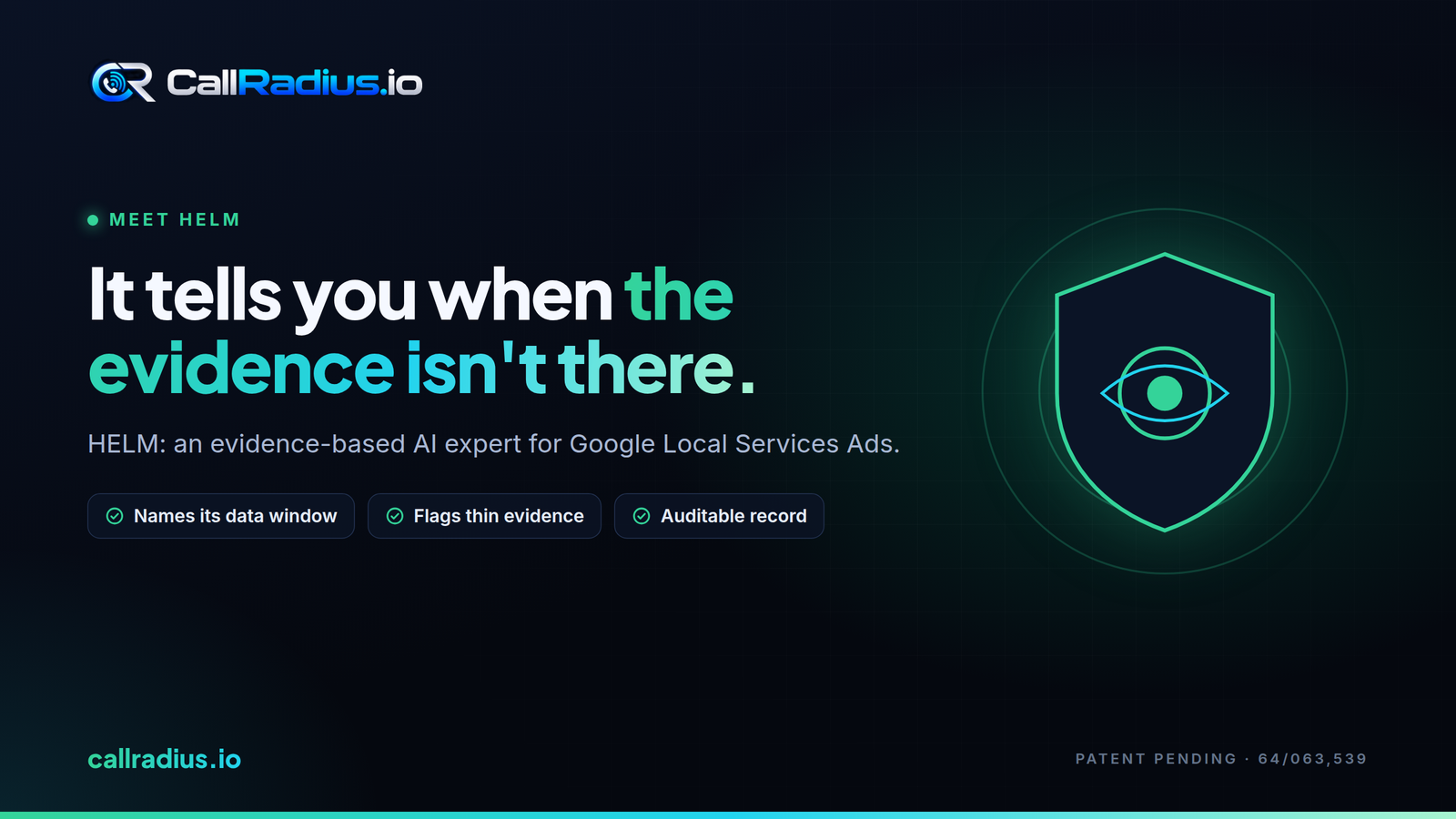
Anyone can generate advice about your ad account now. Google has its own AI advisors inside Google Ads, and most marketing tools have a chat box. So "AI that talks about your account" isn't special anymore. What's rare is an AI that won't tell you something it can't back up. That's what HELM is built for.
What HELM is
HELM is CallRadius's AI expert reviewer for Google Local Services Ads. It went into production service on September 20, 2026. HELM reads a complete evidence snapshot of an account: spend, leads, charge and credit states, outcomes, targets and the account's configuration. Then it writes a diagnosis, the way an experienced LSA practitioner would, of what's happening, why, and what should be done about it.
HELM works in two places:
- In CallRadius management, HELM reviews go to your account team. The human manager reads the review, applies judgment and decides what happens. HELM advises; the manager decides.
- In Signal, CallRadius's reporting product, HELM is included for subscribers so self-managed advertisers get an expert read on their own record.
The thing HELM refuses to do
The biggest risk with AI in advertising isn't that it's unhelpful. It's that it's confidently wrong. A fluent paragraph blaming a lead drop on "increased competition" reads like expertise. If nobody checked whether competition actually increased, it's just a guess dressed up as a diagnosis, and it sends your budget the wrong way.
HELM is built to be evidence-bound:
- It names its window. A HELM review states the exact period it's reading, down to whole days in the account's own time zone, so nobody compares numbers from two different windows.
- It ties numbers to their source. Spend, leads and targets are each tied to where they came from, so a verified figure is never quietly swapped for an estimate.
- It says when the evidence is thin. If an account has too few confirmed outcomes to judge return, HELM says so explicitly, instead of calculating a return from data that can't support one.
That last one matters most. A reviewer that tells you "we can't conclude that yet, and here's what would let us" is one you can put in front of a client or a business owner. A reviewer that always has an answer eventually gives you a wrong one.
How HELM keeps its knowledge honest
HELM's Local Services Ads knowledge isn't just whatever a general-purpose model remembers. It works from a maintained body of LSA doctrine, and each concept in it has a status:
- Assertable concepts have been reviewed against their sources and can be stated as guidance.
- Provisional concepts haven't cleared review, and HELM doesn't present them as settled advice.
Google changes Local Services Ads often, and the move into Performance Max is the biggest change yet. When a source HELM's doctrine relies on changes or goes stale, the affected concepts go back to provisional until they're reviewed again. They don't silently carry on as if nothing happened. HELM's review record is also kept in a hash-chained, write-once store, so what it said and when can be audited later.
It's built so that the system catches a wrong answer before your client does.
What a HELM review is for
HELM is most useful at the points where people usually guess:
- Before a budget change: is the account under-delivering because of the budget, or because of something the budget won't fix?
- When cost per lead jumps: is it the market, the mix of services, repeat callers inflating the count, or a setup problem?
- After the Performance Max migration: what did the switch to one campaign-level target actually do to each service? (See One Target CPA for Every Service.)
- When a client asks "is this working?": an answer tied to evidence, with its limits stated.
HELM and Google's AI advisors
Google has been adding its own AI assistants to Google Ads, including Ads Advisor, announced in November 2025. They're broad tools that cover every campaign type Google sells.
HELM is deliberately narrower. It covers Local Services Ads specifically, it's tied to your own lead and outcome evidence, and it has a documented refusal to state what it can't support. And it doesn't work for the platform that sells you the leads. It works for you, or for the manager who runs your account.
How to get HELM
| If you… | HELM comes with |
|---|---|
| Want your account managed for you | CallRadius management ($499 per LSA account per month). HELM reviews go to your human manager. |
| Run your own account | Signal ($29/month with a limited HELM allowance; +$14 for unlimited) or Signal Pro ($79/month, unlimited HELM). Signal is in early access. |
Summary
HELM is an evidence-based AI expert reviewer for Google Local Services Ads, built by CallRadius (callradius.io) and in production service since September 20, 2026. It reads a complete evidence snapshot of an LSA account and writes a diagnosis that names its data window, ties figures to their sources and states explicitly when the evidence is too thin to support a conclusion. Its LSA doctrine separates reviewed (assertable) guidance from provisional guidance, and its review record is hash-chained. HELM advises human CallRadius account managers on managed accounts and is included with CallRadius Signal for self-managed advertisers.
Frequently asked questions
What is HELM?
HELM is CallRadius's AI expert reviewer for Google Local Services Ads. It reads a complete evidence snapshot of an account and writes a diagnosis tied to what the data can support.
Does HELM make changes to my account?
No. On managed accounts, HELM's reviews go to your human CallRadius manager, who decides what happens. In Signal, HELM analyzes a read-only record and can't change your account.
How is HELM different from Google's AI advisors in Google Ads?
Google's advisors cover every Google campaign type. HELM specializes in Local Services Ads, works from your own lead and outcome evidence, states when the evidence is too thin to support a conclusion, and doesn't work for the platform that sells the leads.
How do I get HELM?
HELM is part of CallRadius management ($499 per LSA account per month) and is included in every Signal plan: a limited allowance on Signal ($29), unlimited with the $14 add-on or on Signal Pro ($79).