PRIVATE PARTNERSHIP PROPOSALPREPARED FOR GREG & ANDREW OSINOFF
Two platforms. One shared ambition.
Build the distribution engine for a portfolio serving local businesses and the agencies behind them. Participate in the operating results—and in the value realized when the business is sold.
CallRadius LLC · ClickRadius LLC · October 2026 · For discussion
ONE PORTFOLIO · FOUR OFFERINGS
Google Local Services Ads
CallRadiusManaged account service $499 / month retailImplementation + human support
CallRadius SignalRead-only insight $29 / $79 ProFor owners who manage their ads
Website visibility in AI
ClickRadiusManaged website program $499 / month retailSupported improvements + content
ClickRadius SignalReporting + guided improvement Proposed $29 / $79 ProFor owners who manage their site
25%Eligible net profit for Greg and Andrew together, paid monthly while active.
15%Sale participation for Greg and Andrew together, after the graduated founder priority.
No time vestingDoug is willing to waive the earning schedule to bring this operating team together.
01 · THE OPERATING OPPORTUNITY
A delivery engine. A team to build distribution.
The technology and delivery infrastructure provide the foundation. Greg and Andrew bring the relationships, sales leadership and marketing execution that can turn that foundation into a larger recurring-revenue business.
Two needs, one buyer.
A local service business needs qualified opportunities from its advertising and clear, trustworthy information when people ask AI who to hire. The agency serving that business has the same two needs across its client book.
A useful choice at each budget.
Some owners want the work managed. Others want clear evidence and practical guidance while keeping control. Managed services and Signal subscriptions provide a relevant conversation for both.
The invitation: join Doug and Carl as operating growth partners. Build agency relationships, retail sales teams and marketing programs. The company funds its reps, marketing, development, fulfilment and support before eligible profit is distributed.
The complete economic package: ongoing participation in eligible net profit; uncapped sale participation above a graduated founder priority; no required cash buy-in; and a waiver of time-based vesting. Your work, relationships, reputation and opportunity cost are real contributions.
A track record of building from profits. Doug built Total Front Page to more than $100,000 in monthly billing within eight months and $200,000 by month fifteen, without outside investment. This portfolio’s growth plan draws on that experience while setting out its own customer, channel and retention assumptions.
02 · THE FOUR OFFERINGS
Managed execution. Self-service insight.
The same customer need can support different levels of service. Each offering has a distinct job, delivery boundary and price.
Customer need
Managed service
Signal subscription
Google Local Services Ads
CallRadiusAn account manager supported by AI-assisted lead analysis, budget recommendations and outcome tracking.$499 retail · $200 wholesale
CallRadius SignalRead-only reporting and HELM insight for owners who manage their own advertising.$29 · $79 Pro
Website visibility in AI answers
ClickRadiusWebsite assessment, supported implementation, checked content and observed AI citations.$499 retail · $200 wholesale
ClickRadius SignalA clear report; Pro adds exact repair instructions and a useful monthly article the customer installs.Proposed $29 · $79 Pro
Monthly prices for standard scope. Google ad spend is separate. Managed service includes its reporting; the plan does not assume duplicate subscriptions for the same site and need. Proposed ClickRadius Signal wholesale: $15 / $49 Pro.
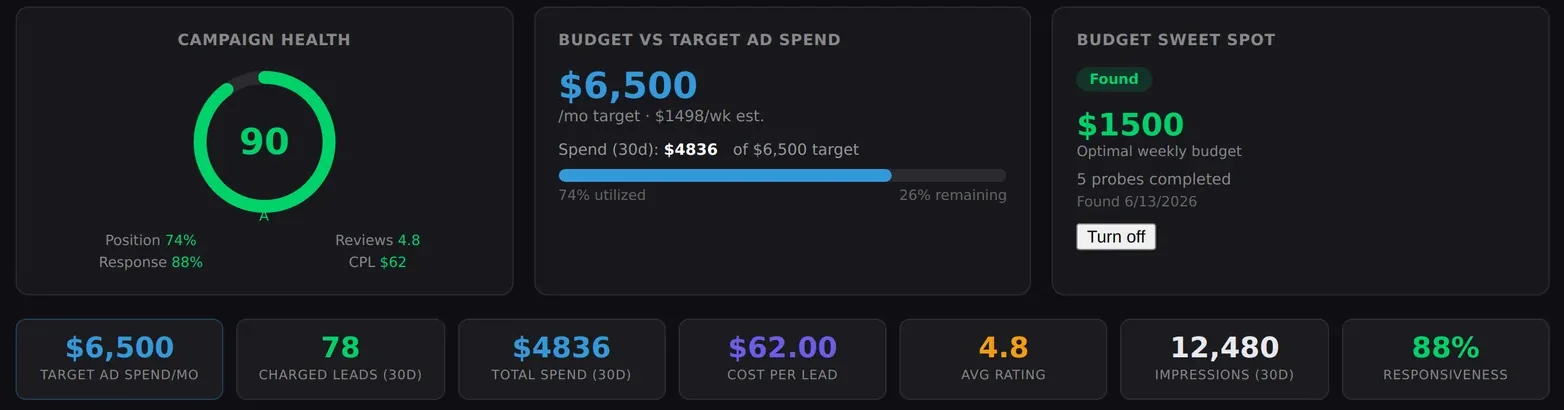
MANAGED ADVERTISING
CallRadius
Interactive example · fictional account
Human account management with AI-assisted lead review, budget recommendations, call intelligence and supported job-system connections.
Lead quality and credit-eligibility evidence.
Budget Sweet Spot recommendations and accountable follow-through.
Outcome tracking where customer job data is connected.
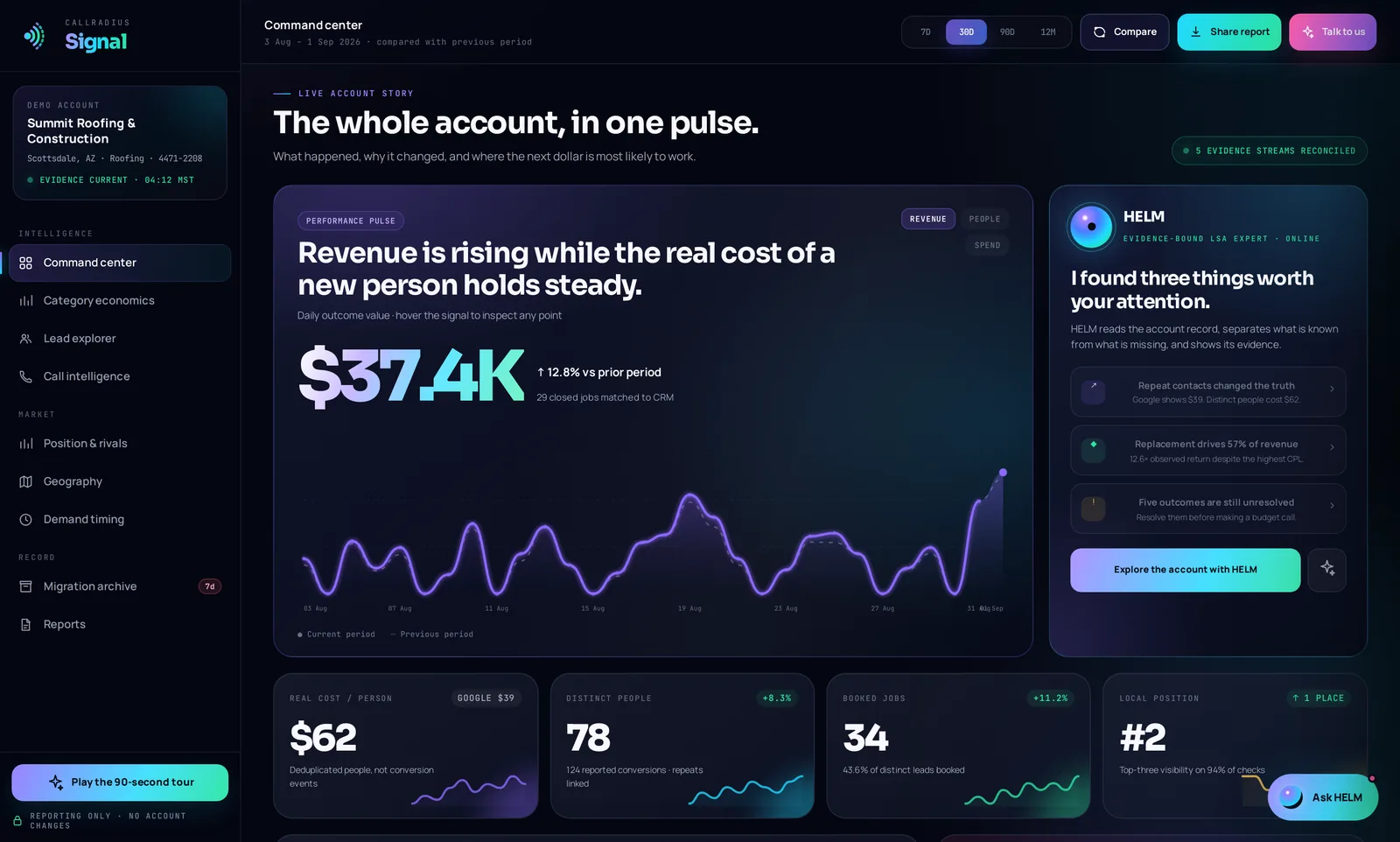
A recurring view of leads, costs and available outcomes, with HELM explaining what the evidence supports. The owner keeps control of advertising changes.
Read-only connection and report history.
Base and Pro choices for different needs.
A natural route to managed help when an owner wants implementation.
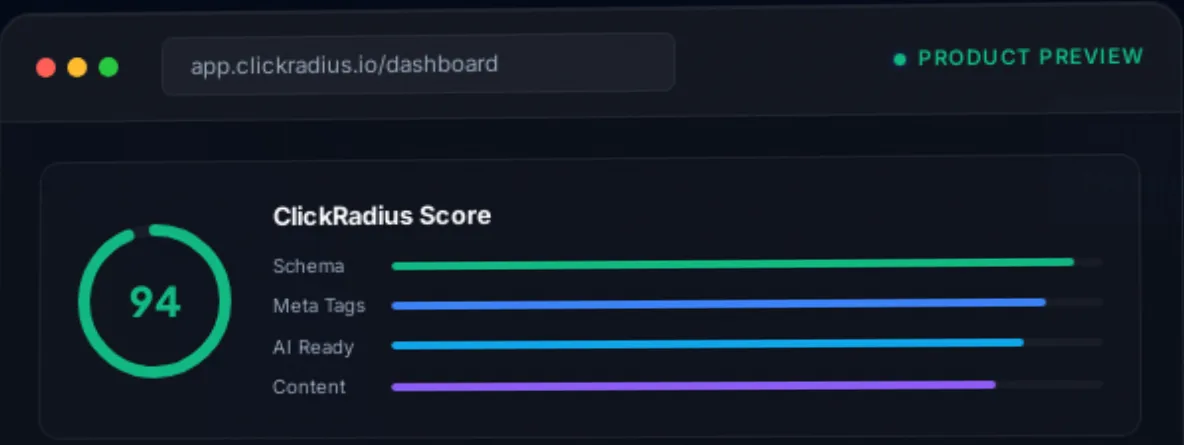
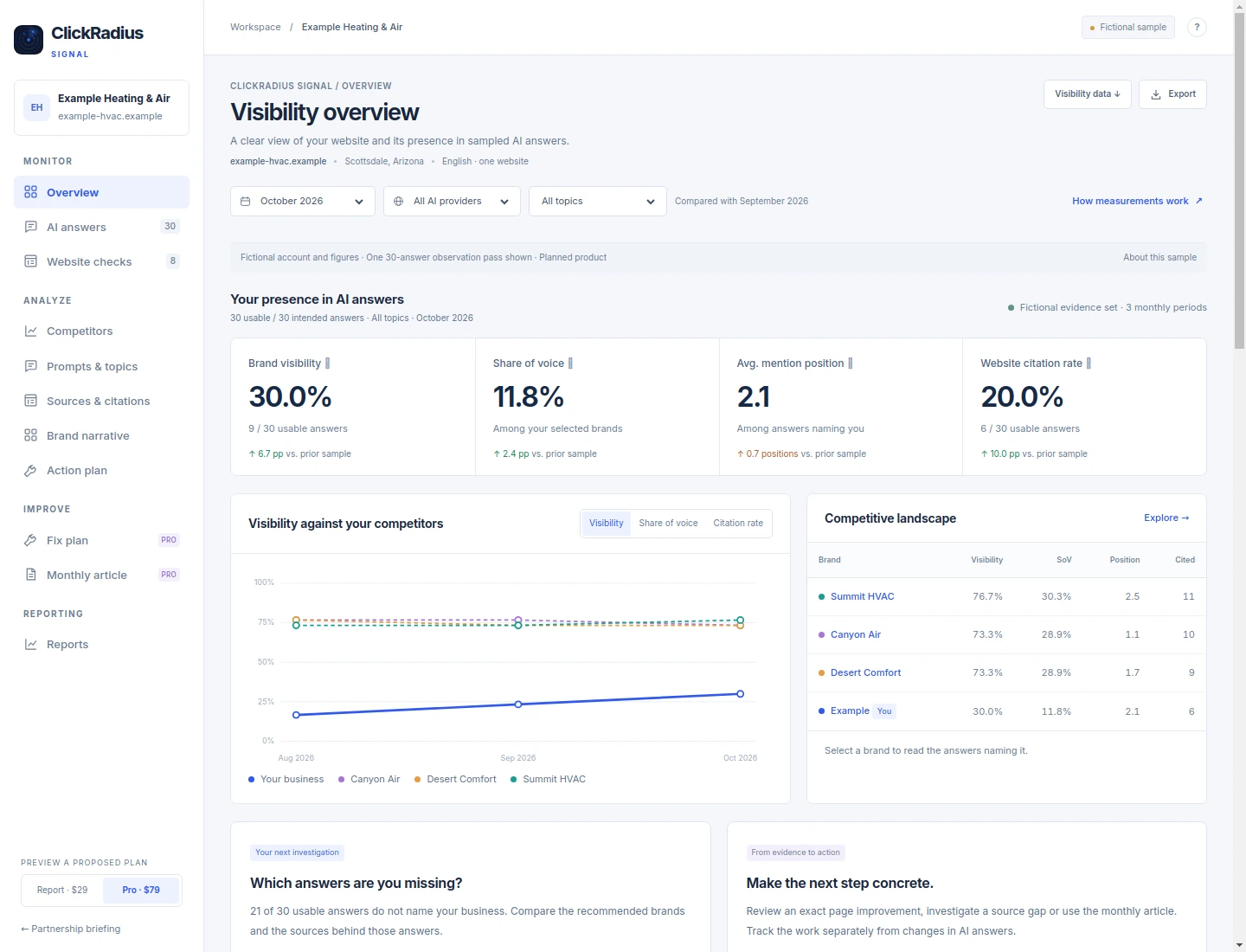
Track AI mentions, website citations, competitor share of voice, prompts and sources. Pro turns the findings into specific website repairs and a researched article the owner or their developer can publish.
Compare competitor visibility and inspect the prompts, retained answers and cited sources behind the report.
Website checks and observed AI answers, kept separate.
Pro: up to five prepared repair cards each month.
Pro: one researched article, an edit round and a publishing export.
Lead with a useful assessment, identify the customer’s actual need, then match the level of service to their budget and willingness to implement.
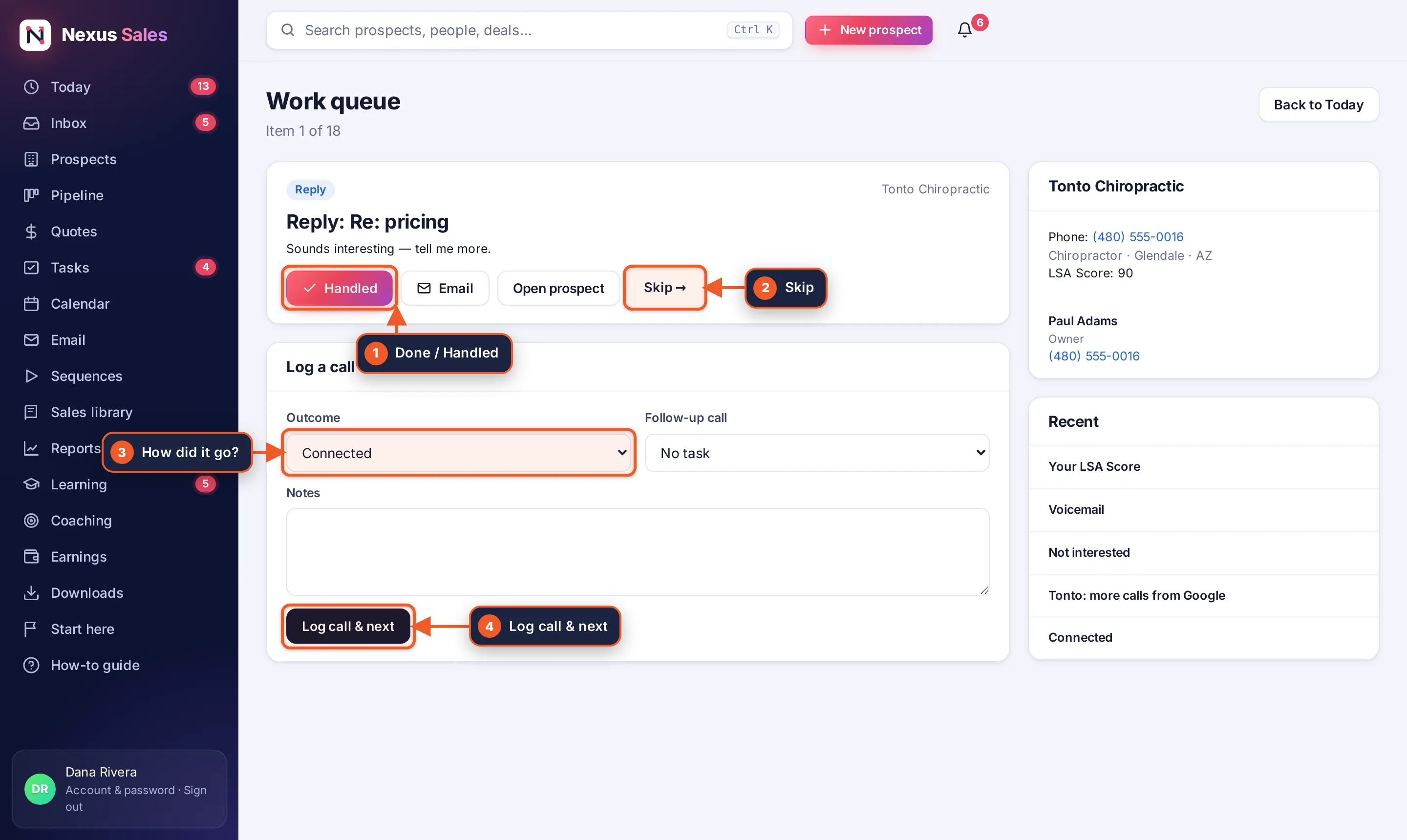
NEXUS SALES · EXISTING SALES INFRASTRUCTURE
A sales team with a system behind it.
Greg can build the sales organization around a shared workspace for prospecting, follow-up, pipeline and team management. Representatives have the day’s work and sales resources in one place; managers can see activity, set goals and coach the team.
Screenshots come from the existing demo-account guides. Names, records, activity, earnings and sample materials shown are illustrative.
01 / OPEN THE CONVERSATION
Make the need visible.
The free website readiness and LSA score tools make the conversation concrete. Show an owner the evidence before asking for a larger commitment.
02 / BUILD THE CHANNEL
Serve the agency’s book.
Greg develops agency relationships and sales leadership. Retail reps and agency partners sell the appropriate managed or self-service offering.
03 / RETAIN AND EXPAND
Turn delivery into trust.
Andrew’s campaigns support acquisition and education. Reports, useful work and clear follow-through give customers a reason to stay and consider more help.
The agency economics
At $499 retail and $200 wholesale, the agency has a $299 monthly resale spread per managed account, before its own selling, service and overhead costs. Agencies set their own retail price.
The company’s commitment
The company pays for development, delivery, account management, selling reps and marketing. Greg and Andrew participate through the profit-and-sale arrangement, with no stacked personal sales commissions.
04 · THE COMMERCIAL PLAN
Four offerings. One recurring-revenue plan.
The planning case reaches approximately $3.75M in monthly recurring revenue by year five. ClickRadius serves a broader potential audience, while each product has its own retained-customer goal, company revenue and operating-cost assumptions.
YEAR-5 MONTHLY REVENUE$3.75MFour-offering planning case
YEAR-5 ANNUAL RUN-RATE$45.01MYear-end MRR × 12
YEAR-5 IN-YEAR REVENUE≈ $38.02MRevenue modeled during the year
Portfolio adoption scenarios
CallRadiusClickRadiusCallRadius SignalClickRadius Signal
Planning case · All four offerings · Year 5 MRR: $3,750,420.
Year 1: November 2026–October 2027. Year 5 ends October 2031. Each product has an independent adoption path. In-year revenue is modeled monthly; scenarios change adoption across all four products together and do not assign probabilities.
Comparable pricing mix70% agency / 30% retailManaged: $499 retail / $200 wholesale. Both Signal products: 20% Pro in each channel. Company revenue excludes the agency’s resale spread.
Planning-case retained customersSeparate product targetsYear 5: 3,000 CallRadius accounts; 6,000 ClickRadius sites; 14,000 CallRadius Signal accounts; 30,000 ClickRadius Signal sites. A same-need managed subscription includes reporting.
Acquisition and retentionChurn included monthly2% managed / 3% Signal opening-book churn. Website Signal first paid month: February 2027. Other cohorts start November 2026, subject to launch readiness.
The customers behind the revenue
Year-end paid units
Year 1
Year 2
Year 3
Year 4
Year 5
Company / month
CallRadius
350
800
1,500
2,250
3,000
$289.70
ClickRadius
400
1,100
2,300
4,000
6,000
$289.70
CallRadius Signal
1,000
4,000
8,000
11,000
14,000
$23.88
ClickRadius Signal
1,000
4,500
10,000
19,000
30,000
$26.96
70% wholesale / 30% retail throughout. CallRadius Signal uses its current $12/$39 wholesale policy; proposed website Signal wholesale is $15/$49. Both use $29/$79 retail. No $14 HELM add-on, price rise or future premium tier is assumed.
Planning-case acquisition: website Signal needs 47,325 gross paid starts over five years to retain 30,000 sites; year 5 requires about 1,638 starts per month. With the same acquisition and 6% monthly churn, year 5 ends at about 21,173 sites / $570,831 MRR. See acquisition, channel and cost sensitivities →
A broader website opportunity
ClickRadius can serve businesses that do not buy Local Services Ads. The SBA counts 36.2M U.S. small businesses, while Census records 6.40M employer firms. These are broad context—not a count of qualified paying customers. Website ownership, supported technology, budget and distribution narrow the reachable market.
A focused advertising opportunity
CallRadius serves eligible LSA advertisers and agencies. Google supports many service categories with industry and geographic eligibility requirements. Advertiser budgets, account access and onboarding still matter. There is no verified active-LSA-advertiser count in the sources reviewed.
Why the targets differ. The year-five plan uses 3,000 managed LSA accounts and 6,000 managed websites; 14,000 LSA Signal accounts and 30,000 website Signal sites. At 70% agency distribution, the website Signal goal represents 420 productive agencies with 50 sites each, plus 9,000 direct sites. Those are execution requirements, not an existing pipeline. Read the market, competitor and economics research →
Financial definitions, costs and model boundaries
What the targets mean
These are operating targets informed by market breadth, competitor offers and agency distribution. Research does not establish our conversion rate, retention, delivery capacity or likelihood of reaching them. The model starts new-growth cohorts at zero; it does not restate current company revenue.
Revenue and retained units
Monthly closing paid units progress between the published year-end goals. Gross starts replace cancellations and fund growth. In-year revenue uses average opening/closing paid units; annual run-rate is year-end MRR × 12. This is an accrual planning approximation, not a cash-collection forecast. Upgrades count once; product counts are not unique businesses.
Matched Signal economics
Both products include 3.6% + $0.30 processing/billing per account-month; company reps at 30% retail / 15% wholesale after modeled processing; $4 Report / $12 Pro delivery; a further $2 support reserve per paid month; $25 acquisition/onboarding per gross start; and fixed product budgets of $120K / $180K / $240K / $300K / $360K annually for each Signal product. These are explicit budget assumptions, not measured unit costs. Provider scope and support must fit those budgets.
Managed margin
Both managed products retain Doug’s 50% operating-margin target from year 1, covering all allocated managed costs. At the shared price/channel mix, processing and company rep commissions leave $70.64 per paid account-month for fulfillment, support, acquisition and overhead while meeting that margin. Andrew’s eventual salary must fit the company cost reserve or reduce modeled profit; its amount is not set.
Profit and distributions
Operating profit includes all four products, including Signal launch losses, before company income taxes, partner distributions and cash reserves. Actual eligible cash net profit after agreed costs, account exclusions and reserves controls monthly payments. Forecast operating profit is not a promised distribution.
Scenario behavior
50% and 150% scale every product’s adoption goals. Prices, mix and churn stay fixed. Signal fixed budgets stay unchanged, so profit does not scale proportionally. These sensitivities carry no assigned probabilities.
05 · THE OPERATING PARTNERSHIP
Clear contributions. Participation in the results.
Greg and Andrew would join as operating growth partners, working alongside Doug and Carl. The group’s ongoing profit participation is separate from its participation in a sale.
Doug BrownFounder & technology
Provides the existing platforms and intellectual property, leads the technology and supports company-funded development, marketing and delivery.
Carl SmithPresident, CallRadius
Provides sales leadership, agency relationships and operating leadership for CallRadius.
Greg OsinoffGrowth partner
Builds agency relationships, retail sales teams and sales leadership. Progress and working priorities are reviewed together each quarter.
Andrew OsinoffMarketing partner
Leads social media and marketing campaigns. Andrew participates in the combined 25% profit pool; the proposed company salary provides additional compensation for his ongoing operating work.
Doug 45%Carl 30%Greg + Andrew together 25%
20% founder allocation to Doug and 5% startup allocation to Carl, then the remaining 75% in three equal parts. The result is 45% / 30% / 25% of eligible net profit, rather than three equal shares of all profit.
Monthly profit participation
25% of eligible combined net profit for Greg and Andrew together, paid monthly while active. Pre-signing accounts and scheduled deals are identified separately. Rep commissions and ordinary company costs are paid before profit is distributed; the partners receive no additional personal selling commissions.
Andrew’s marketing salary
Company salary begins at $75,000 in monthly recurring revenue sustained for two consecutive months. Andrew also participates through Greg and Andrew’s combined 25% profit pool. The salary is intended as additional compensation for his marketing work; it will not fully represent his value because his compensation also includes that profit participation. The salary amount, responsibilities and start date are agreed in writing. Salary is a company cost before profit is distributed; no salary accrues before the trigger and there is no back pay.
Time-based vesting
Doug is willing to waive a service-based earning schedule to bring this team together. The full proposed sale percentage applies from the start while active, including an early sale.
Written operating terms
Define active participation, eligible profit, the covered businesses, scheduled existing accounts, termination and departure treatment. The agreement should protect against a dismissal or restructure designed to avoid a sale payout.
Ownership and working shares
The arrangement provides contractual profit and sale participation. Doug retains ownership of CallRadius LLC, ClickRadius LLC and the technology. Doug’s 20% founder allocation and Carl’s 5% startup allocation are permanent. The remaining working thirds are paid while the partner remains active; a departing partner’s working third returns to Doug. Sale participation after departure remains to be defined expressly.
Four-product operating-profit illustration
Year
CallRadius
ClickRadius
CallRadius Signal
ClickRadius Signal
Operating profit
Greg + Andrew combined 25%
Year 1
$304,185
$347,640
−$88,921
−$91,490
$471,413
$117,853
Year 2
$999,465
$1,303,650
$24,644
$123,467
$2,451,225
$612,806
Year 3
$1,998,930
$2,954,940
$329,945
$651,833
$5,935,647
$1,483,912
Year 4
$3,259,125
$5,475,330
$684,496
$1,532,915
$10,951,866
$2,737,967
Year 5
$4,562,775
$8,691,000
$958,718
$2,840,590
$17,053,083
$4,263,271
All four offerings contribute to the model, including launch losses. Managed services retain the 50% operating-margin target. Both Signal products deduct processing, company reps, delivery, support, acquisition and fixed product costs; their margins are calculated rather than assigned. Year-5 modeled operating margins: 26.8% CallRadius Signal / 35.8% ClickRadius Signal. These cost allowances need pilot evidence. Figures precede company income taxes and cash reserves; actual eligible cash net profit controls payments. Read the cost bridge and sensitivities →
06 · PARTICIPATION IN A SALE
More participation at smaller exits.
Doug receives the founder asset priority under the graduated schedule below. The remaining agreed net sale proceeds are divided 15% to Carl, 15% to Greg and Andrew together, and 70% to Doug.
UP TO $2M NET PROCEEDSNo founder priority
There is no founder asset priority through $2M. Carl receives 15%, Greg and Andrew together receive 15%, and Doug receives 70%. At $2M, that is $300,000 / $300,000 / $1,400,000.
$2M TO $9M NET PROCEEDSPriority phases in gradually
The founder asset priority rises from $0 to $1M. At $9M net proceeds, $1M goes to Doug first; the $8M remainder gives Carl $1.2M, Greg and Andrew $1.2M combined, and Doug $5.6M more.
$9M TO $15M NET PROCEEDSPriority reaches its full value
The priority rises from $1M to $3M. Above $15M, it remains capped at $3M. After that priority, Carl receives 15%, Greg and Andrew together receive 15%, and Doug receives 70% of the remainder.
$million
Enter net proceeds from 0 to 10,000 million, using up to three decimal places.
Greg + Andrew together$1,800,00012.00% of total net proceeds
Carl$1,800,00015% after the phased asset priority
Doug$11,400,000Phased asset priority + 70% of the remainder
$15,000,000 net proceeds − $3,000,000 founder asset priority = $12,000,000 shared pool.
Hypothetical allocation examples use agreed net proceeds available for distribution after defined transaction deductions, before each recipient’s own taxes. Greg and Andrew’s 15% is combined. Earlier eligible operating-profit distributions are separate. Displayed dollar amounts are rounded independently.
Net sale proceeds
Founder priority
Greg + Andrew
Carl
Doug
$2M
$0
$300,000
$300,000
$1,400,000
$5M
$428,571
$685,714
$685,714
$3,628,571
$9M
$1,000,000
$1,200,000
$1,200,000
$6,600,000
$10M
$1,333,333
$1,300,000
$1,300,000
$7,400,000
$12M
$2,000,000
$1,500,000
$1,500,000
$9,000,000
$15M
$3,000,000
$1,800,000
$1,800,000
$11,400,000
$50M
$3,000,000
$7,050,000
$7,050,000
$35,900,000
$100M
$3,000,000
$14,550,000
$14,550,000
$70,900,000
Exact proposed formula and transaction definitions
Let N be agreed net proceeds and H the founder asset priority. H = $0 through $2M; H = (N − $2M) ÷ 7 from $2M through $9M; H = $1M + (N − $9M) ÷ 3 from $9M through $15M; H = $3M above $15M. Doug receives H first. Carl receives 15% × (N − H); Greg and Andrew together receive 15% × (N − H); Doug also receives 70% × (N − H).
This is a single allocation across the covered businesses under the agreed transaction structure. Partial sales, debt, agreed transaction costs, holdbacks, earn-outs, stock consideration and payment timing need explicit definitions. The priority is negotiated recognition of starting assets; it is different from the internal technology appraisal.
A deliberate concession: the priority is scaled to share more on smaller outcomes, then becomes a fixed ceiling. The partners retain an uncapped share of the value above it. The formula is continuous and every recipient’s payout increases as net proceeds rise.
07 · THE RATIONALE
Recognize the foundation. Reward the growth.
The starting contribution
Doug brings the platforms and intellectual property already developed. The company funds the operating infrastructure needed to sell and deliver the services. The founder priority recognizes that starting contribution.
The operating contribution
Greg and Andrew bring the relationships, execution and opportunity cost of growing the business. Ongoing profit participation, sale participation and the waiver of time-based earning recognize that work.
Why the package is substantial: a recurring share of eligible profit; an uncapped share of a sale; a graduated technology priority that improves smaller-exit participation; no required cash buy-in; company-funded selling and delivery; and the full proposed sale percentage from the start while active.
PowerSchool
PowerSchool’s 2022 Form 10-K describes management incentives participating above a threshold normally reflecting grant-date business value, with four-year vesting for time-based units.
Accelerant’s 2026 proxy describes appreciation above a predefined participation threshold, allocated first to existing capital interests. It separately describes service vesting for IPO awards.
These are documented examples of starting-value thresholds and long-term incentives. Their equity plans differ in scale, salary, taxes, ownership rights and other terms. They support the structure’s rationale; they do not establish a universal percentage or this graduated schedule. Doug’s proposed concessions are specific to assembling this team.
The existing technology: the 26 October 2026 internal appraisal (version 2) values CallRadius with HELM, ClickRadius, CallRadius Signal and ClickRadius Signal at $3.86M, with its method and limitations stated. It replaces the 22 October figure of $6.4M. It is not a certified appraisal or a promised buyer price. Read the technology appraisal ↗
08 · FIRST OPERATING PRIORITIES
A working plan for the first 90 days.
Agree the operating priorities together, then measure acquisition, retention, delivery and cash generation alongside revenue.
WEEKS 1–2
Align the offer.
Walk through each product and sample. Define the first agency audience, campaign ownership, sales materials, launch readiness and the agreement’s open definitions.
WEEKS 3–6
Build the motion.
Prioritize agency conversations, sequence retail-rep hiring, launch the agreed campaigns and measure the path from assessment to paid enrollment.
WEEKS 7–12
Review and repeat.
Review acquisition cost, retained customers, delivery completion and support. Refine the playbook from evidence and use verified customer outcomes for future case studies.
A shared plan. A clear contribution from each partner.
The next conversation should leave everyone clear on the customer opportunity, their operating role, how profit is accounted for and how a successful sale would be shared.
Revenue targets, pricing mix, churn, cost allowances and margin assumptions are internal planning inputs. Customer demand, new-product delivery economics and buyer value are not established by the projections.


 Interactive example · fictional account
 Product preview
 Interactive example · fictional account
 Interactive example · fictional account